The short version
- A 3t sign limits the total weight of your vehicle, its load and any trailer.
- Disobeying a gross or bridge load limit sign is a $330 fine (NSW, as at 1 July 2025).
- Going over a load limit by up to 1 tonne is $423, and by up to 2 tonnes $844.
- For a heavy vehicle, a sign-posted limit can also lead to a mass breach under the HVNL.
- A truck over 4.5 tonnes GVM needs at least a Light Rigid (LR) licence.
In this article
- What Does a 3 Tonne Limit Sign Mean?
- What Is the Fine for Driving on a 3 Tonne Limit Road in NSW?
- Can a 3 Tonne Limit Breach Become a Heavy Vehicle Offence?
- How Much Weight Can a 3 Tonne Truck Carry?
- Can You Drive a 4.5 Tonne Truck on a Car Licence in NSW?
- Practical Tips for Drivers and Operators
- Recent Case Results
- Frequently Asked Questions
- Received a Fine for a 3 Tonne Limit Road?
NSW road rule fines are as at 1 July 2025. Heavy Vehicle National Law (HVNL) penalties apply from 1 August 2026 to 30 June 2027. Fines change regularly, so check the amount on your penalty notice.
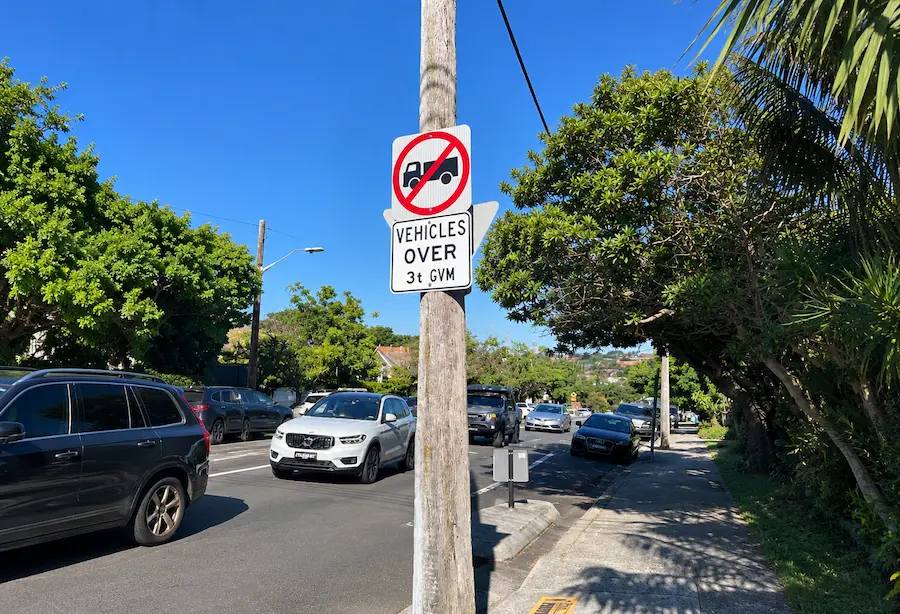
If you drive a truck, a loaded ute or a vehicle towing a trailer in NSW, you have probably seen a sign showing “3t” on a local street or bridge. Ignoring it can lead to a fine, and for heavy vehicles it can also open the door to a mass breach under the Heavy Vehicle National Law (HVNL).
Here is what these signs mean, who they apply to, and what happens if you get it wrong.
What Does a 3 Tonne Limit Sign Mean?
NSW uses a few different weight signs. The rules depend on which one you are looking at.
- Light traffic road (weight restriction) signs. If a weight restriction sign is displayed for a road, you must not use that road if the total weight of your vehicle, including its load, is the same as or heavier than the weight shown on the sign.
- Gross load limit and bridge load limit signs. You must not drive past a gross load limit sign or bridge load limit (gross mass) sign if the total gross mass of your vehicle, and any vehicle connected to it, is more than the mass shown on the sign. The gross mass includes any load on the vehicle at the time.
The practical point: these signs are about the whole package. That includes your load and any trailer you are towing, not just the truck on its own. A light truck or ute towing a loaded trailer can easily go over 3 tonnes.
Always read the full sign, including any plate underneath it. The sign itself tells you what is being measured and whether any exception applies.
3 tonne limits vs “No Trucks” signs
A “No Trucks” sign is different. Drivers of long or heavy vehicles, except buses, must not drive past a No Trucks sign unless the vehicle is within the mass or length shown on the sign.
Where the sign gives no detail, no truck with a gross vehicle mass (GVM) over 4.5 tonnes may drive past it. The exception is where the driver’s destination lies beyond the sign and it is the only route.
What Is the Fine for Driving on a 3 Tonne Limit Road in NSW?
These are the NSW penalty notice amounts published by Transport for NSW, as at 1 July 2025:
Disobey gross load limit sign
Law: Road Rules 2014, rule 103(1)
Fine: $330
Disobey bridge load limit (gross mass) sign
Law: Road Rules 2014, rule 103(1)
Fine: $330
Disobey bridge load limit (mass per axle group) sign
Law: Road Rules 2014, rule 103(2)
Fine: $330
Laden mass exceeds limit notice by not more than 1 tonne
Law: Road Transport (General) Regulation 2021
Fine: $423
Laden mass exceeds limit notice by not more than 2 tonnes
Law: Road Transport (General) Regulation 2021
Fine: $844
Disobey No Trucks sign (GVM)
Law: Road Rules 2014, rule 104(1)
Fine: $235
The NSW guide does not list demerit points for these offences. NSW fines are reviewed regularly, so check the current amount on your penalty notice.
There is one major exception. Disobeying a No Trucks sign on the road crossing Galston Gorge carries a $4,783 fine and 12 demerit points.
Fined on a 3 tonne limit road?
Get advice before you pay or respond. The first step often shapes the outcome.
Can a 3 Tonne Limit Breach Become a Heavy Vehicle Offence?
Yes, it can. The NHVR explains that a heavy vehicle’s mass limit is the lowest of the manufacturer’s limits, the general mass limits, and any other limit such as one set by a sign for a bridge or road.
So if you are driving a heavy vehicle (GVM over 4.5 tonnes) past a sign-posted limit, you may face more than a road rules fine. You could also be dealing with a mass breach under the HVNL, which carries much higher penalties. See our guide to overloading fines in NSW.
How Much Weight Can a 3 Tonne Truck Carry?
It depends on what “3 tonne” means for your vehicle.
Gross vehicle mass (GVM) is the maximum loaded mass of a vehicle, as set by the manufacturer or the registration authority. If the registration authority’s GVM is lower than the manufacturer’s, the registration figure applies.
To work out how much you can carry, take the GVM and subtract what the vehicle weighs empty, including fuel, fittings and the driver. What is left is your payload. You will find the GVM on the vehicle’s compliance plate (vehicles built before 1 July 2021) or on the Register of Approved Vehicles (vehicles built after 1 July 2021).
Remember: being under your GVM does not mean you can use a 3 tonne limit road. A vehicle can be legal for its own GVM but still too heavy for the sign.
Can You Drive a 4.5 Tonne Truck on a Car Licence in NSW?
In NSW, a Class C (car) licence covers cars, utes, vans and some light trucks, up to 4.5 tonnes GVM.
If the truck’s GVM is more than 4.5 tonnes, you need at least a Class LR (Light Rigid) licence. This covers rigid vehicles with a GVM of more than 4.5 tonnes but not more than 8 tonnes. Above 8 tonnes, you need a Medium Rigid (MR) or Heavy Rigid (HR) licence, depending on the number of axles.
Check the GVM on the plate, not the vehicle’s empty weight. Driving without the right licence class is an unlicensed driving offence. For a first offence where the required class is C, R, LR or MR, the NSW guide lists a $704 fine.
Practical Tips for Drivers and Operators
- Check the sign and any plate under it before turning into a local street.
- Know your vehicle’s GVM and your actual loaded weight, including any trailer.
- Plan routes in advance, especially for deliveries in residential areas.
- If you rely on a destination exception, keep your delivery or job details handy.
- Make sure the driver holds the right licence class for the vehicle’s GVM.
Recent Case Results
Parramatta Local Court · November 2025
Charge: Severe risk overmass
Maximum penalty: $75,100
RESULT: $7,500 FINE
See more results for heavy vehicle operators
Case outcomes depend on the individual facts and circumstances of each matter. Past results do not guarantee or predict future outcomes.
Frequently Asked Questions
What is the fine for driving on a 3 tonne limit road in NSW?
Disobeying a gross load limit or bridge load limit sign is a $330 fine (NSW, as at 1 July 2025). If your laden mass exceeds the limit by up to 1 tonne the fine is $423, and by up to 2 tonnes it is $844.
Do 3 tonne limit signs apply to utes and trailers?
Yes. The limit applies to the total weight of the vehicle, its load and anything connected to it. A light truck or ute towing a loaded trailer can easily go over 3 tonnes.
How much weight can a 3 tonne truck carry?
Take the vehicle’s gross vehicle mass (GVM) and subtract what it weighs empty, including fuel, fittings and the driver. What is left is your payload. The GVM is on the compliance plate or the Register of Approved Vehicles.
Can you drive a 4.5 tonne truck on a car licence in NSW?
A Class C (car) licence covers vehicles up to 4.5 tonnes GVM. If the truck’s GVM is more than 4.5 tonnes, you need at least a Light Rigid (LR) licence.
What does a No Trucks sign mean if no weight is shown?
No truck with a GVM over 4.5 tonnes may drive past it, unless the driver’s destination lies beyond the sign and it is the only route.
Can a 3 tonne limit breach become a heavy vehicle offence?
Yes. A heavy vehicle’s mass limit is the lowest of the manufacturer’s limits, the general mass limits and any sign-posted limit, so driving past the sign can also be a mass breach under the HVNL.
Received a Fine for a 3 Tonne Limit Road?
A load limit fine can look minor. But if the vehicle is a heavy vehicle, it may also attract attention from the NHVR about mass, records or other compliance issues. If the NHVR follows up, read our guide on what to do if you’re contacted by the NHVR in NSW.
Eric Navea is a heavy vehicle defence lawyer and a former Senior Prosecutor at the National Heavy Vehicle Regulator (NHVR). He knows how these matters are assessed and when they escalate. Eric will identify the immediate issues, important deadlines and the information needed to properly assess your position.
Received a fine or a letter from the NHVR? Speak with Eric before you respond.
Speak With Eric Before You RespondDisclaimer
This article is general information only, current as at 14 October 2026, and is not legal advice. Fine amounts are current as at the dates shown and may change. Your situation depends on your own facts, so speak with a lawyer before responding to a fine or the NHVR.